So I thought this meme (credit to @swordlesbianopinions) was always pretty delightful and a lil while back due to many things, but in part prompting from a couple of friends who know what a big sword nerd I am, I finally opted to throw together a list of sword designs I’d associate with the different pride flags (based primarily on the sword’s literal design, not history). Obviously, this is a lot of personal opinion, but hey, it’s all for fun. Enjoy!
“While You Were Being Heterosexual, I Studied The Blade“
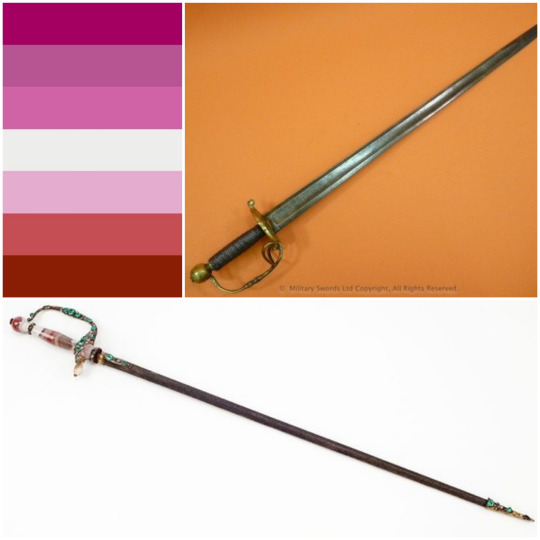
Lesbian first, bc that’s the OP’s orientation.
Backsword.
Beautiful, fast, delicate, single-edge, evolution of the Falchion meets fencing sword.
Also, it was the design used for the Sword of Dios in Utena & Pearl in SU. (Pretty sure Utena just copied this: http://elfgrove.tumblr.com/post/111286499668)
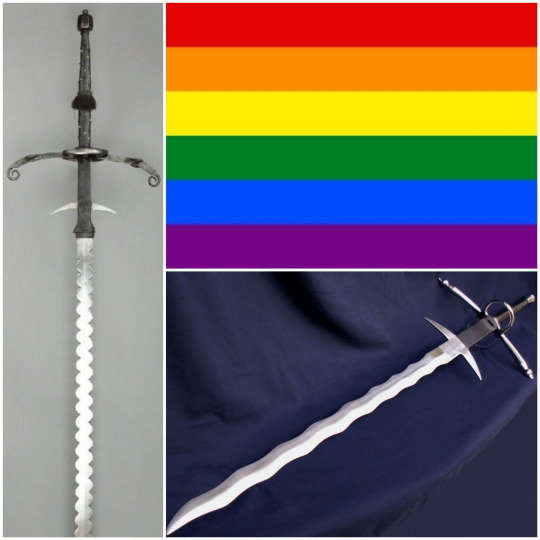
Rainbow flag. TheFlamberge.
Large and flashy, slightly slower movement but powerful, memorable/iconic, double-edged, more of a display of the swordsmith’s skill than practical weapon, but damn they’re fun.
Also, have fun with the flaming puns.
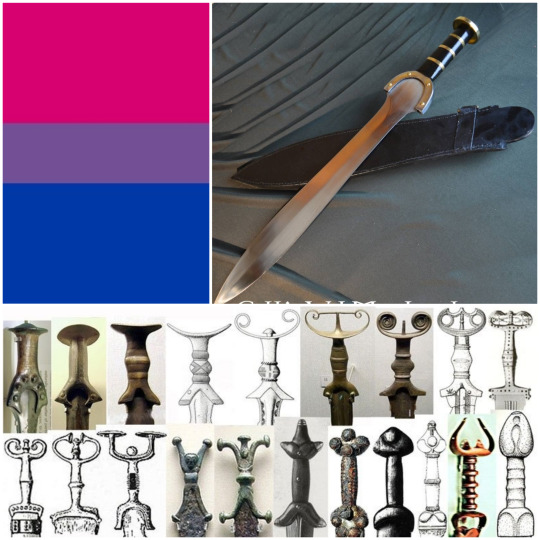
Bisexual flag.
Leaf-bladed Greek Xiphos or Celtic Hallstatt sword.
Double-edged, smaller and swift, but heavy for its size. Lends to a wide range of use and style and has a great deal of creative variety in the hilt.
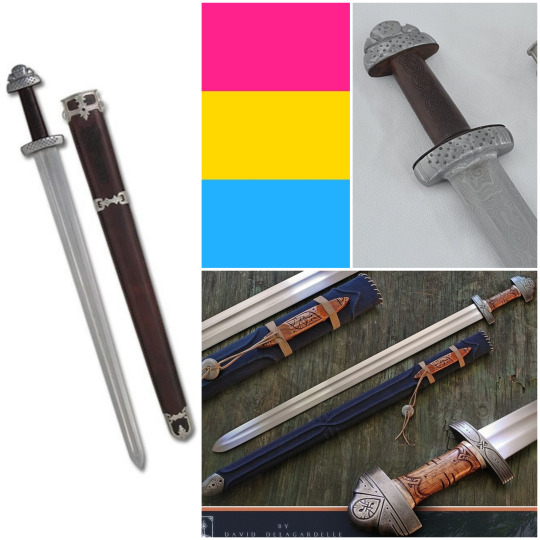
Pansexual flag.
Trondheim Viking sword.
Double-edged, a relative to the Greek Xiphos, longer, lighter, a bit more generic a profile, but good and highly versatile blade that lends towards minimal simplistic but elegant hilt designs and blade etchings and little crossguard if any.
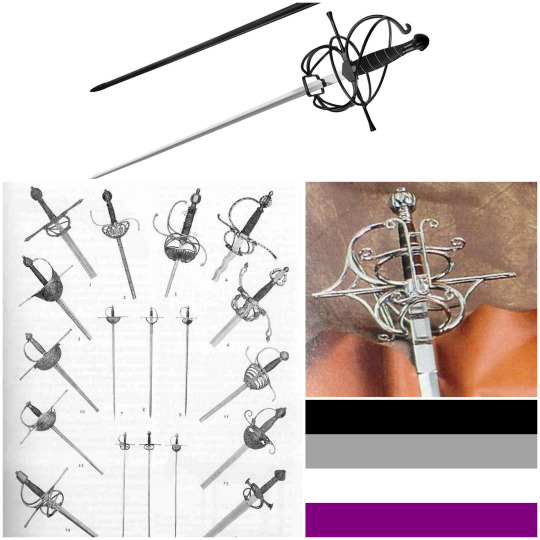
Asexual flag.
Rapier.
Usually double-edged. Long, thin blades with a great deal of reach. Fast cut-and-thrust usage style. Iconic for the elaborate and decorative basket hilts that while pretty also deflect attacks to protect the wielder. Often paired with a parrying dagger. (Appropriate since Ace folk often “dual wield” multiple labels.)
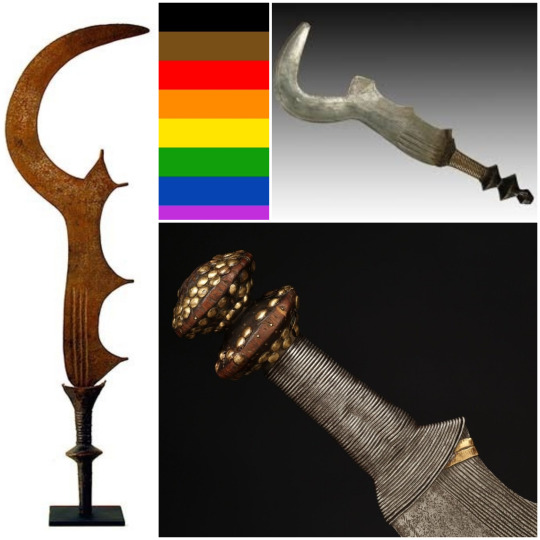
More Color More Pride Flag.
Ngombe.
A traditional sword from the Congo region. Beautiful, strongly detailed, and large, used as a symbol of prestige and sometimes in ceremonial dance or as currency. Colonization spread now-debunked myths of it being used as a slave/animal execution tool.
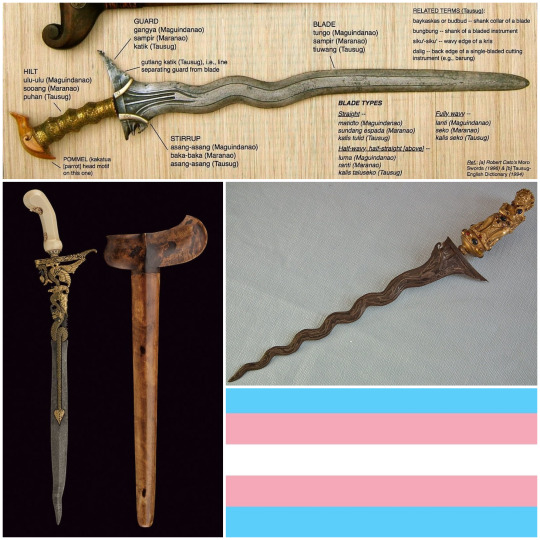
Transgender flag.
Kris/Keris.
An Indonesian short sword. Asymmetrical. Double edged. Triangular guard that is a part of the blade. Beautifully detailed blades requiring complex smithing and are both a weapon & spiritual. They can be hard & intimidating or delicate pieces of art.
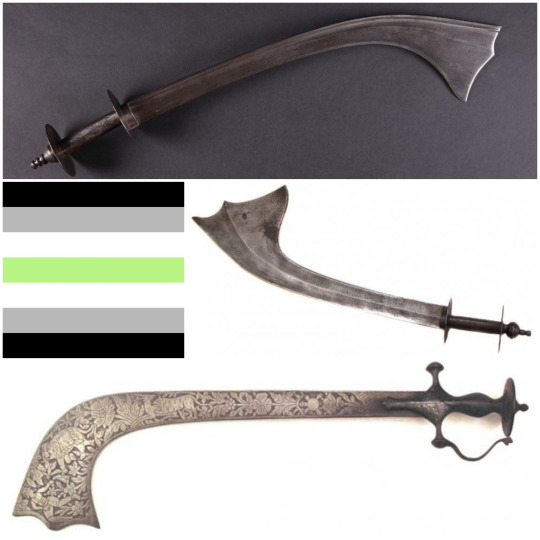
Agender flag.
Kora.
Single-edged. An unusual sword design wherein the inside curve is the sharp edge. The curve lends power and the flared end is both decorative and adds weight to the force of a swing. Designed for slashing rather than thrust-style fighting. Typically practically adorned but sometimes features artistic engraving on the blade and gilded details.
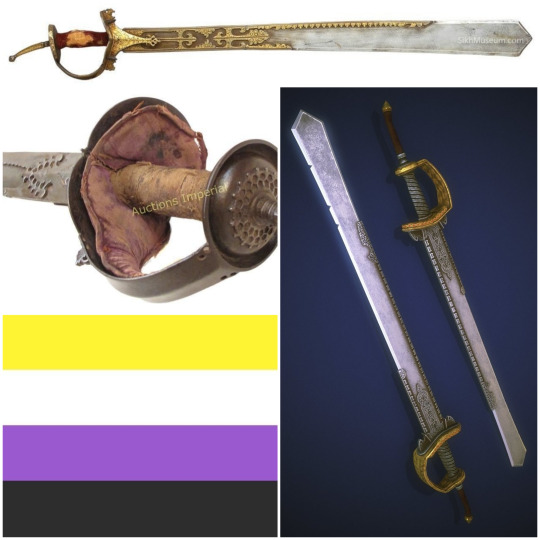
Non-binary flag.
Khanda.
Double-edged but most of one edge is encased in a strengthening plate. Features a widened flat tip that eliminates thrusting from usage. Effective for slashing & versatile for single or dual wielding. Pommel hook or strengthening plate can serve as a grip. Can be very practical in appearance or highly decorative and gilded.
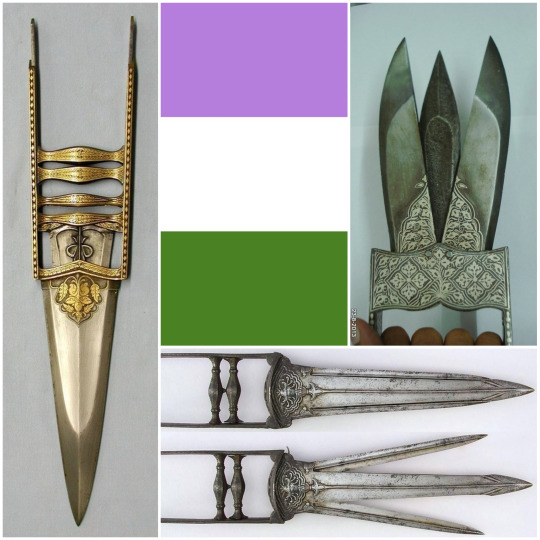
Genderqueer flag.
Scissors Katar. A variety of push dagger. These wide, beautifully decorative blades open into 3 via a spring (usually) mechanism. Despite colonialist rumor they exist to cause excessive harm, recent theory is the mechanism is actually defensive, meant to act as a sword catcher and breaker rather than for viciously gutting opponents.
Edit: Added by request.
Aromantic flag. Stiletto. A chronically underestimated and misunderstood blade. Stilettos are most commonly thought of as a defensive parrying dagger to a rapier, and while they can be used as such, stilettos exist both as daggers and as swords. Stilettos were actually first designed as a purely offensive weapon and the secondary weapon of knights to be used to efficiently cut through mail or armor right to the “heart” of the problem at hand. Stilettos are also well known as a concealed blade such that most cane swords are actually stilettos.They are iconic in that even when made with edges, it is not designed to be useful for cutting or slashing but rather is a thrusting (stabbing) blade usually forged from a single piece of metal. They are at the height of thier intended usage as an “edgeless” sword/dagger. They can be highly artistically decorated or simple and practical as suits the wielder’s tastes.
Genderfluid Flag. Haladie is a sidearm blade originating in ancient Syria and India. It is a wavy (usually) two bladed, double edged dagger connected by a single hilt, but a three bladed version is not uncommon, the third blade (or spike) set up to work double duty as both a finger guard and knuckle duster, and there are cases of Haladie with even more blades set across the guard. They are designed for swift, flexible usage with quick shifts between what edges are being employed. Haladie are robust as both slashing and stabbing weapons. As seen above, it can vary between being very plain or gilded, but even when decorated, is kept designed for use.
Feel free to request I add flag/sword matchups for orientations I didn’t get to on the first pass at this.



 magicpotatolover